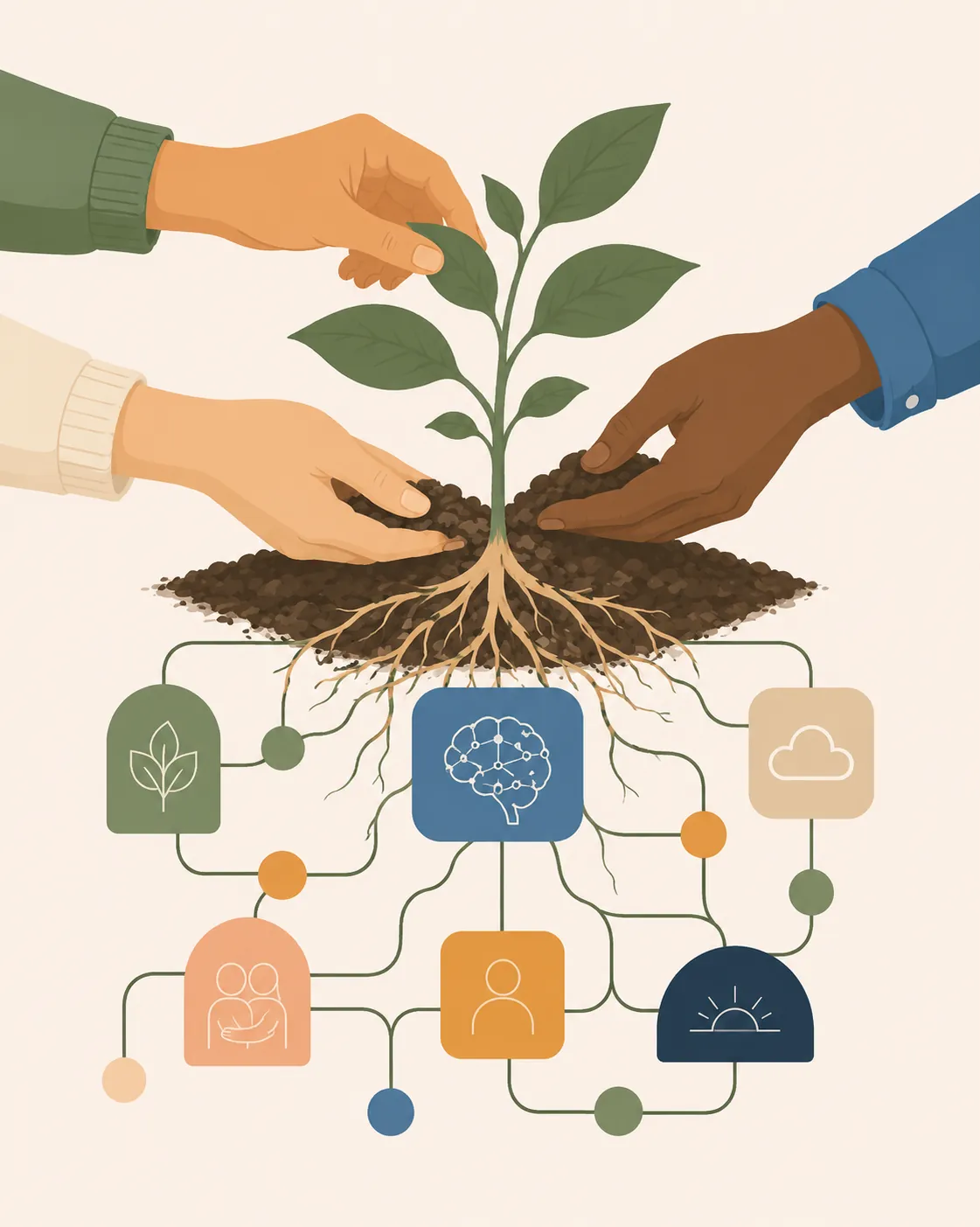
Every few weeks, the AI conversation goes back to the same two arguments: it’s going to save us, or it’s going to break us. We build software for a living, so we’ve learned to trust neither. The tools we work with aren’t saviors and they aren’t villains. They’re unusually powerful (and expensive) mirrors, and most of what scares people about them is a reflection staring back.
That’s the part worth studying. The failures we file under “AI” turn out, on closer inspection, to be old human problems wearing new clothes. The Machine didn’t invent any of them. It scaled them, sped them up, and handed us the receipts.
The problems were already ours
Bias is the cleanest case. A model trained on the open internet picks up the internet’s prejudices right alongside its grammar. So when it hands back a skewed answer, technically, it isn’t broken. It’s doing precisely what it was built to do, on the data we gave it. The 2021 paper that nicknamed large language models “stochastic parrots” said it about as plainly as anyone has: these systems replay the patterns in their training data, the ugly ones included.1 The bias is ours. The model just won’t be polite enough to hide it.
Then there’s the energy bill, which is real and still climbing. The International Energy Agency expects data center electricity use to clear 1,000 terawatt-hours by 2026, roughly everything Japan burns through in a year.2 Training a single large model can boil off hundreds of thousands of liters of fresh water for cooling, and even a quick back-and-forth costs you a small bottle’s worth.3 But a data center’s footprint comes down to how we decide to power and cool the thing. That’s an infrastructure problem. AI made it urgent. It didn’t make it new.
And underneath all the magic, there’s the labor. The “safety” of a friendly chatbot usually rests on people paid a few dollars an hour to wade through the worst material on the internet so the rest of us never have to see it. A 2023 investigation found workers in Kenya doing exactly that, for under two dollars an hour, absorbing the psychological cost on our behalf.4 That’s not a glitch in the neural network. It’s a question about how we value and protect labor, and it’s a good century older than any model.
AI did not invent our blind spots. It scaled them, and handed us the receipts.
The same tool, pointed the other way
Here’s the more hopeful half of this argument. If these systems are powerful enough to amplify our worst habits, they’re powerful enough to help us work on those habits too, including the mess they make themselves. Our favorite example is almost too on the nose: years before the current boom, the same type of system that strains a data center’s power budget was used on that data center’s cooling and cut the energy by roughly forty percent.5 AI, more or less literally, helping solve the AI problem.
Point the tools at genuinely hard things and the payoff stops being theoretical. AlphaFold mapped the shape of nearly every protein known to science and gave the structures away to more than two million researchers, work that took a share of the 2024 Nobel Prize in Chemistry.6 Machine learning has turned up a new structural class of antibiotics, the first in decades, against bacteria that had stopped responding to everything else.7 It’s learned to hold the superheated plasma inside a fusion reactor steady, one small step on a very long road to clean power.8 None of these are chatbots polishing your emails. They’re people reaching, with a new instrument, for things that used to sit out of reach.
What we would rather do with it
We’re not naive about the dark side. A tool that can design a protein can design a pathogen. A tool that can tidy your inbox can bury everyone else’s. Power cuts both ways. It always has. But the lesson we keep relearning, project by small project, is that the technology doesn’t set the outcome. The hands touching it do. So do the incentives around it, and the care somebody takes in the moments nobody bothers to photograph.
Which is why opting out entirely strikes us as the surest way to guarantee the worst version of all this. Refusing to touch AI doesn’t slow it down one bit. It just hands the wheel to whoever has the fewest second thoughts about where it’s headed. We’d rather be in the room, building slowly, asking out loud who eats the cost of each decision, treating “because we could” as a warning instead of a reason.
AI isn’t going to shape the future on its own. It’s a tool, and tools take the shape of the hands that hold them. The real question was never whether the machine saves us or sinks us. It’s what we mean to do with it.
References
- Bender, E. M., Gebru, T., McMillan-Major, A., & Shmitchell, S. (2021). "On the Dangers of Stochastic Parrots: Can Language Models Be Too Big?" Proceedings of FAccT '21. dl.acm.org
- International Energy Agency (2024). "Electricity 2024: Analysis and Forecast to 2026." iea.org
- Li, P., Yang, J., Islam, M. A., & Ren, S. (2023). "Making AI Less 'Thirsty': Uncovering and Addressing the Secret Water Footprint of AI Models." arXiv:2304.03271. arxiv.org
- Perrigo, B. (2023). "OpenAI Used Kenyan Workers on Less Than $2 Per Hour to Make ChatGPT Less Toxic." TIME. time.com
- Google DeepMind (2016). "DeepMind AI Reduces Google Data Centre Cooling Bill by 40%." deepmind.google
- Jumper, J., et al. (2021). "Highly Accurate Protein Structure Prediction with AlphaFold." Nature. Recognized with a share of the 2024 Nobel Prize in Chemistry. nature.com
- Wong, F., et al. (2023). "Discovery of a Structural Class of Antibiotics with Explainable Deep Learning." Nature. nature.com
- Degrave, J., et al. (2022). "Magnetic Control of Tokamak Plasmas Through Deep Reinforcement Learning." Nature. nature.com